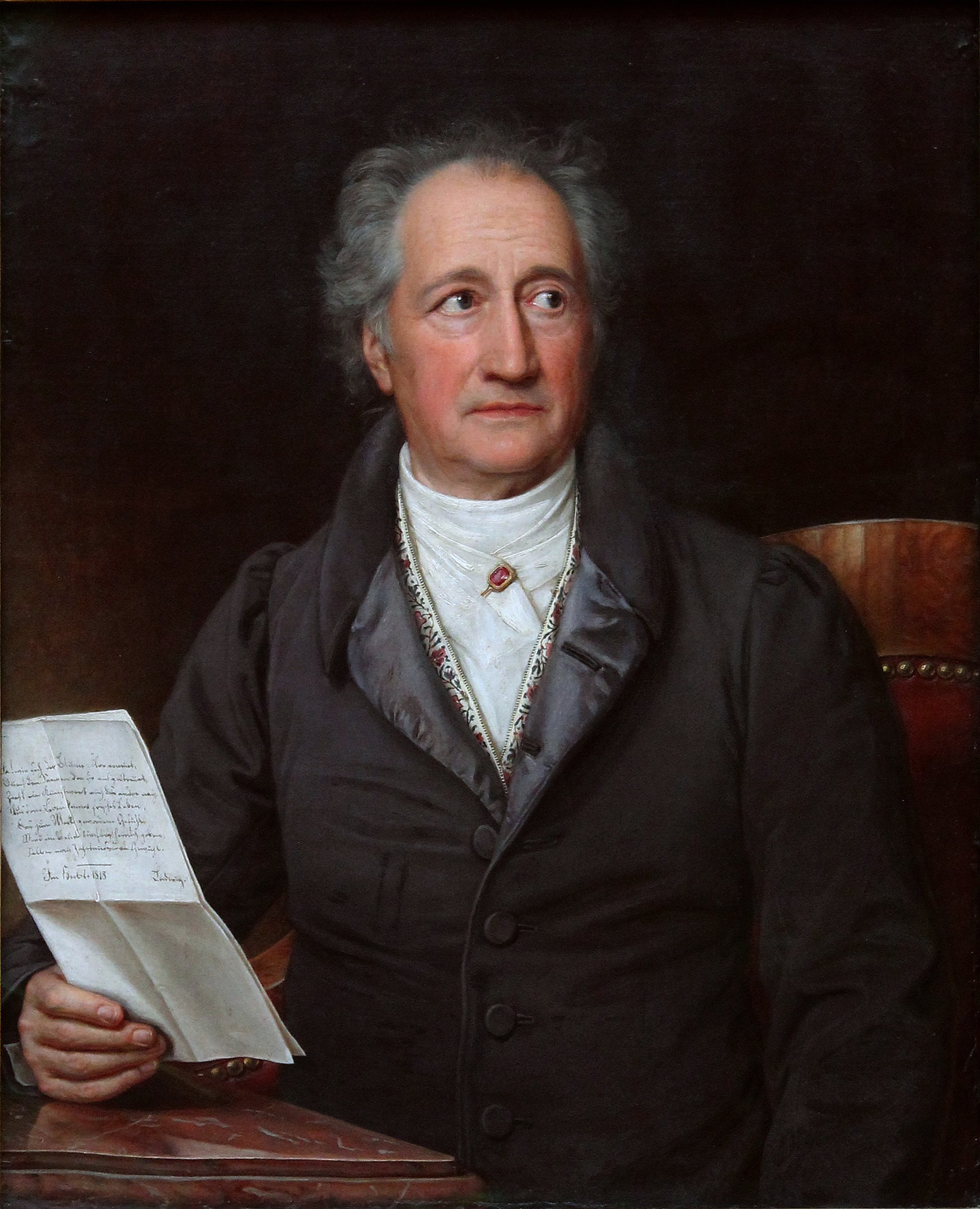
Johann Wolfgang von Goethe:
Where Science and Poetry Become One
In the modern world, we often divide human creativity into neat categories: scientists on one side, poets on the other. Logic here, emotion there. Equations versus metaphors. Yet history reminds us that this division is artificial. Few figures embody this unity more powerfully than Johann Wolfgang von Goethe (1749–1832), a man who lived comfortably at the crossroads of science and poetry.
Goethe was not a poet who merely admired science from afar, nor a scientist who occasionally wrote verse. He was both — fully, deeply, and unapologetically.
A Poet Shaped by Nature
Goethe’s poetry is inseparable from the natural world. Flowers, light, seasons, color, growth, and transformation appear again and again in his verses. Nature for Goethe was not a background decoration; it was a living, thinking presence.
Unlike poets who romanticize nature abstractly, Goethe observed it carefully, almost scientifically. He believed that true poetry begins with attention — the ability to see what others overlook.
One of his most famous poetic ideas was that nature has no inside or outside:
“Nature has neither kernel nor shell;
She is everything at once.”
This line is not only poetic — it is philosophical and scientific. Goethe rejected the idea that nature hides a single secret core. Instead, he believed meaning is revealed through direct experience.
Goethe the Scientist (Yes, Truly)
Many readers are surprised to learn that Goethe made serious scientific contributions, especially in an era dominated by figures like Newton.
🌿 Botany and Morphology
Goethe developed the concept of plant morphology, proposing that all parts of a plant (leaf, petal, stem) are transformations of a single underlying form. This idea of unity through transformation later influenced biology and evolutionary thinking.
🌈 Theory of Color
In his major scientific work, Theory of Colours, Goethe challenged Newton’s purely mathematical treatment of light. While modern physics did not fully adopt Goethe’s conclusions, artists and philosophers embraced his insight that human perception matters — that color is not only a physical phenomenon but a psychological one.
🦴 Anatomy
Goethe also identified the intermaxillary bone in humans, helping establish anatomical continuity between humans and other mammals — a subtle but important contribution.
Faust: The Scientist as a Tragic Poet
Goethe’s masterpiece, Faust, may be the greatest literary expression of the scientist-poet conflict ever written.
Dr. Faust is a scholar who has mastered philosophy, medicine, law, and theology — yet feels empty. His tragedy is not ignorance, but excess knowledge without wisdom. Faust wants to understand life completely, even if it costs his soul.
In Faust, Goethe asks a timeless question:
What happens when knowledge grows faster than meaning?
This question feels especially relevant today, in an age of artificial intelligence and technological acceleration.
Why Goethe Still Matters Today
Goethe’s legacy speaks directly to our modern condition:
- In a world obsessed with specialization, he reminds us of wholeness
- In a time of data overload, he calls for direct experience
- In an era of speed, he teaches deep observation
For poets, Goethe is proof that intellect does not weaken poetry — it strengthens it.
For scientists, he shows that imagination is not the enemy of truth.
A Lesson for Poets and Thinkers
Goethe once wrote:
“Knowing is not enough; we must apply.
Willing is not enough; we must do.”
This line captures his entire philosophy. Poetry should not float above life, and science should not detach from human feeling. Both are ways of engaging with reality.
At Alumniyat, where poetry is understood as a living force rather than a decorative art, Goethe stands as a guiding figure — a reminder that the poet and the thinker can be one voice.
✨ In One Sentence
Johann Wolfgang von Goethe was not a poet who loved science, nor a scientist who wrote poetry — he was a human mind refusing to be divided.